Subterranean termite soil trenching in San Antonio addresses subterranean colony activity driven by shallow limestone shelves, fluctuating caliche soil moisture, and dense seasonal swarms. Termite colonies build…
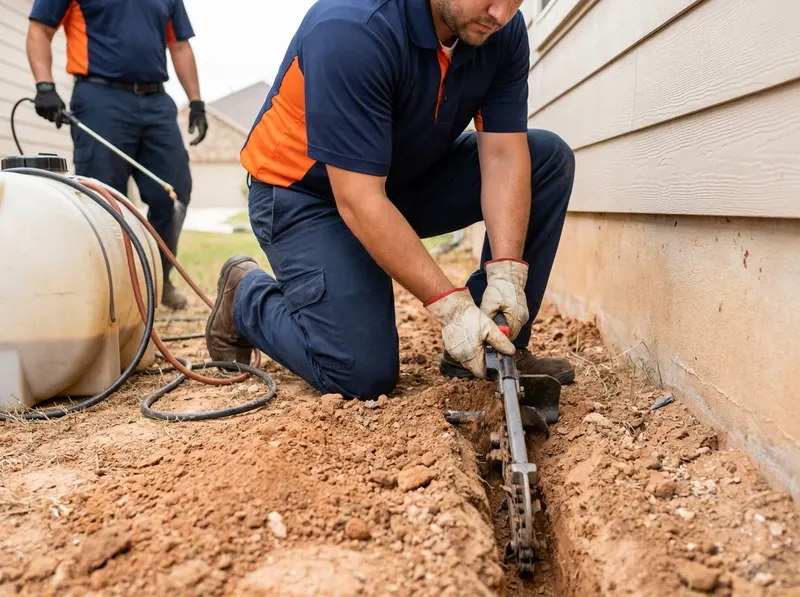
Subterranean termite soil trenching in San Antonio addresses subterranean colony activity driven by shallow limestone shelves, fluctuating caliche soil moisture, and dense seasonal swarms. Termite colonies build subterranean mud shelter tubes upward from the damp earth to breach concrete slabs, plumbing penetrations, and expansion joints. Applying liquid non-repellent termiticide requires excavating a continuous 6-inch-wide by 6-inch-deep trench immediately flush with the perimeter slab edge. The soil removed from this trench is treated with termiticide at a standard rate of 4 finished gallons per 10 linear feet per foot of depth, adhering strictly to EPA pesticide safety standards. As worker termites navigate through this undetectable zone, they absorb and transfer the active ingredient through mutual grooming and food sharing, systematically collapsing the subterranean colony network without staining walls or dispersing airborne propellants into interior living quarters.
Soil profiles across Bexar County dictate precise application modifications. In northern limestone terrain such as Stone Oak, Helotes Creek, and the Dominion, rock layers often sit 2 to 4 inches below the topsoil, requiring specialized mechanical rodding to drive chemical protection down to the foundation footing. In historic neighborhoods like King William Historic District, Monte Vista, and Alamo Heights, perimeter masonry, flagstone patios, and crawlspace skirting demand precision concrete core drilling through hardscapes to maintain the continuous chemical shield. The Texas A&M AgriLife Extension reports that subterranean termites cause tens of millions of dollars in structural wood damage annually across Central Texas. When foundations border active landscape beds in Southtown, Medical Center, or Oakland Estates, trench backfills are sealed to ensure ground irrigation does not wash the solution away from foundation contact points.
Selecting liquid trench barriers over localized bait station networks depends on structural urgency and construction features. Soil trenching suits properties where subterranean foragers have already breached expansion joints or structural sill plates, because the continuous liquid band provides an immediate protective envelope around the foundation. In contrast, termite baiting systems rely on passive worker discovery over weeks or months, creating a lag period where ongoing wood destruction can continue behind drywall. However, trenching involves labor-intensive earth displacement and requires core drilling through adjacent concrete slabs or attached garages, whereas baiting leaves paved walkways untouched. For continuous monolithic slabs common in San Antonio subdivisions, soil trenching delivers definitive, long-term defense. Diagnostic protocols follow the Integrated Pest Management guidelines set by the Texas Department of Agriculture to protect non-target soil organisms while creating an unbroken subterranean defensive barrier.
Treatment execution follows four methodical steps. First, technicians inspect perimeter walls, expansion points, and interior crawlspaces using high-intensity illumination and moisture meters compliant with standards from the National Pest Management Association. Second, technicians clear back organic mulch, gravel, and drip lines before excavating the 6x6-inch soil channel around the foundation perimeter. Third, sub-slab concrete aprons, porches, and garage thresholds are drilled at 12-inch intervals to inject termiticide directly beneath the paving, aligning with OSHA jobsite safety rules for structural drilling. Fourth, the excavated caliche and clay soil is saturated with the measured volume of termiticide, replaced into the trench, and tamped to restore existing yard grades. For questions regarding active mud tubes or to schedule an on-site property measurement, property owners can call (281) 270-1637.
Every job gets a firm, written price after a free on-site visit.
For standards, safe disposal, and service guidance on pest control services in San Antonio, TX, useful references include U.S. EPA, ENERGY STAR, U.S. Dept. of Energy, Consumer.gov, U.S. Census Bureau, and Google Maps. General consumer and small-business resources are available from USA.gov, Better Business Bureau, FTC Consumer Advice, U.S. Small Business Administration, and Ready.gov.
Tell us about your subterranean termite soil trenching job in San Antonio and we'll send a clear, written quote, usually the same day.
 FalconRoot Extermination